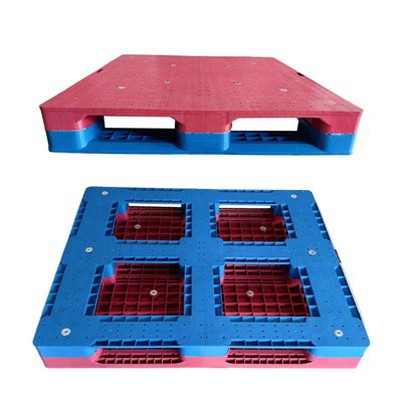
How to Stack Plastic Pallets?
Leave a message

In the field of logistics and warehousing, plastic pallets are widely used. Properly stacking plastic pallets can not only save space, but also improve work efficiency and ensure the safe storage and transportation of goods. So, how should plastic pallets be stacked?
The Benefits of Properly Stacking Plastic Pallets
In warehousing and logistics environments, space is a valuable resource. Correctly stacking pallets can make full use of vertical space and store more goods in a limited area through multi-layer stacking. For example, in a warehouse, neatly stacking pallets of the same specifications can increase the storage density of goods, reduce the floor space, and save storage costs for the company. At the same time, a reasonable stacking method can also make the warehouse layout more compact and orderly, facilitating the storage and management of goods.
Correctly stacking pallets can ensure the stability of goods during storage and transportation. When the pallets are stacked neatly and in compliance with the specifications, the upper and lower pallets can fit tightly together, the center of gravity remains stable, and the risk of goods tipping and falling is reduced. Especially for some fragile, valuable or dangerous goods, stable stacking can effectively prevent damage to the goods, reduce economic losses and safety hazards.
Proper stacking methods can avoid unnecessary squeezing and collision of pallets and goods. For example, evenly distributing the goods on the pallet and stacking them according to the load-bearing requirements can prevent the pallet from being deformed or damaged due to excessive local force. At the same time, a reasonable stacking height can also reduce the friction and collision caused by shaking during the handling process, and extend the service life of the goods and pallets.
Correctly stacked pallets make the access to goods more convenient and quick. Neat stacking makes it easier for warehouse staff to find the required goods and reduce the time to find them. When using forklifts and other handling equipment, standardized stacking of pallets can also ensure smooth and efficient operation, improve handling speed and work efficiency.
Good pallet stacking method helps to optimize the entire logistics process. From the warehousing, storage to the outbound delivery of goods, properly stacked pallets can reduce the number and time of handling and reduce labor intensity. At the same time, it is also convenient to connect with other logistics links, such as the loading and unloading of transport vehicles, and improve the overall efficiency of logistics operations.
Commonly Used Stacking Methods for Plastic Pallets
Overlapping type
Overlapping type is a very common stacking method. Its stacking method is that each layer is stacked in the same stacking direction and order. This method has the advantages of fast operation speed and high pallet utilization rate, and is suitable for goods with neat appearance and large area. However, it also has certain disadvantages, that is, the contact effect between layers is poor, and it is easy to collapse.
Rotational staggered type
The stacking method of rotational staggered type is: the first layer of goods is placed 90 degrees to each other; the second layer is placed in the same way as the first layer, but the direction is 180 degrees different from the first layer of goods; the third layer is placed in the same way as the first layer, and so on. This stacking method has the advantages of good stability and not easy to collapse. However, it also has some disadvantages, such as greater difficulty in operation, and due to the hollow in the middle, the utilization rate of the pallet is not high.
Criss-cross type
The stacking method is that the first layer of goods is arranged horizontally; the second layer of goods is arranged vertically; the third layer refers to the first layer, and so on. This method is simple to operate and suitable for automatic pallet loading operation. The disadvantage is that the contact effect between layers is poor and the stability is poor.
Positive and negative staggered stacking
The stacking method is that the first layer is closely placed in a combination of two horizontal and three vertical; the second layer is also in a combination of two horizontal and three vertical, but in the opposite direction of the first layer; the third layer is based on the first layer; and so on. This method is similar to building bricklaying, with high stability and suitable for goods with neat appearance. The disadvantage is that it is difficult to operate.
How to Stack a Pallet Safely

Check the load and its weight
First, assess what needs to be stacked and how much it weighs. Also, make sure to assess the pallet itself and its condition and load capacity.
The maximum weight that a pallet can safely carry and move depends on several factors, including the type of pallet you use, the type and material of the load being stacked, and the equipment used to move the pallet. A standard 48×40 pallet must have a minimum load capacity of 2,500 pounds, but can typically carry up to 4,600 pounds. Also, load capacity varies depending on the size of the pallet and the method used to store the pallet.
Determine the ideal stacking pattern
Based on the boxes you have, their size, and weight, stack them in the safest palletizing configuration. A key part of a safe pallet is using a pattern that fits the load you are handling. If you have boxes of various sizes and shapes, consider using an interlocking method; if you have boxes of the same size and shape, consider using blocking techniques.
Ensure proper weight distribution
Once you have determined your stacking pattern, you should determine where to place each box to ensure proper balance and weight distribution to avoid injuries or accidents. Heavier loads should be placed at the bottom of the stack first, creating a stable base, and then lighter loads should be placed on top of the stack in order to prevent heavier materials from damaging lighter materials.
Secure boxes with straps, tape, or wrapping paper
Once the load is configured, secure the boxes with straps where needed and add shrink wrap to them. Wrap the entire unit, load, and pallet with multiple layers of plastic wrap to securely tie the items to the pallet. Doing so will help prevent the boxes from shifting and falling during transport, which can cause accidents and injuries.
What is ENLIGHTENING PALLET's Guidance for Safe Pallet Stacking?
ENLIGHTENING PALLET offers comprehensive guidance on safe pallet stacking. Here are some best practices to keep in mind:
Cargo stability
When stacking cargo, always ensure the stability of the cargo. Use suitable pallets, racks or containers so that the cargo can be firmly placed on the fork arms of the forklift. At the same time, properly balance the cargo on the fork arms to prevent the cargo from tilting and sliding.
Stacking and stacking height
"Stacking" refers to stacking one cargo on top of another, while "stacking height" refers to the stacking height of the cargo. When stacking cargo, make sure that the bottom cargo can withstand the weight of the cargo above. At the same time, be careful not to exceed the safe stacking height limit of the forklift to prevent the accidental collapse of the cargo.
Arrangement and organization
Rational arrangement and organization of cargo are key to ensuring safe stacking by forklifts. Put cargo of similar nature or size together so that the forklift can better operate and carry it. At the same time, leave enough aisle space to ensure that the forklift has sufficient maneuverability during operation.
Use markings and instructions
The use of markings and instructions can help forklift drivers identify and locate cargo more quickly. For example, using eye-catching signs, signs or arrows can reduce operating errors and accidents.
Cleaning and maintenance of the stacking area
It is very important to keep the stacking area clean and tidy. Remove garbage, debris or accumulation in time and ensure that the ground is flat to prevent forklifts from being blocked or accidents during movement.

Conclusion
Correctly stacking plastic pallets plays a vital role in improving storage efficiency and ensuring the safety of goods. When using plastic pallets to stack goods, you need to understand the load-bearing capacity of the pallet and place the goods reasonably according to its load-bearing conditions to prevent partial overloading. At the same time, you should choose a suitable stacking method, such as overlapping, criss-crossing or rotating staggered, to adapt to the characteristics of different goods. In addition, you should regularly inspect and maintain the pallet to check whether its appearance is damaged, clean dust and stains in time, and reasonably adjust the stacking height. Only by doing this can you ensure the correct stacking of plastic pallets and improve the level of warehouse management.
Ready to Stack Pallets?
ENLIGHTENING PLAST is a professional manufacturer of plastic pallets and containers. We have a wide range of products, covering all types of plastic pallets. At present, our products have been exported to many countries and regions such as the Middle East, Africa, Southeast Asia, Australia, New Zealand, South America, Europe, etc. If you have any questions about the stacking of plastic pallets, please feel free to contact us and we will solve them for you in time.