Sharps Containers Buying Guide: Sizes, Materials, and Safety Tips
Leave a message
Introduction
In environments such as hospitals, clinics, laboratories, or home injection sites, carelessly discarding sharp objects such as needles and blades can easily lead to accidental injuries and infections. Sharps containers are designed to safely collect and dispose of these sharp wastes. Choosing a compliant, safe, and appropriately sized sharps container not only protects the user but also prevents environmental pollution. This article will guide you in selecting a sharps container correctly based on its size, material, and relevant safety considerations.
Choosing the Right Size: Balancing Safety and Efficiency
The capacity of a sharps container directly impacts usability and safety.
• Insufficient capacity: Frequent replacements are required, wasting resources and increasing the risk of needlesticks during the replacement process.
• Excessive capacity: Difficult to move and space-consuming, with a higher chance of being overlooked for replacement due to extended usage cycles.
Selecting the right size ensures safety while enhancing work efficiency and the standardization of waste management.
Common Capacity Specifications
Sharps containers on the market are mainly categorized by capacity as follows:
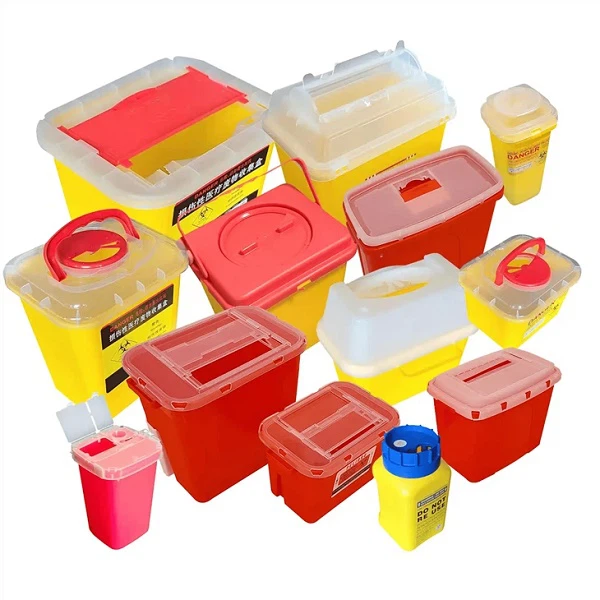
• Small (1–2L): Ideal for home injections, personal care, and mobile nursing services. Compact and portable, they can be discarded once full.
• Medium (3–7L): Suitable for clinics, dental offices, and laboratories with moderate daily usage. Often designed as desktop or wall-mounted units.
• Large (10L and above): Used in hospital departments, hemodialysis centers, or centralized waste collection points. Their large capacity can hold a large number of sharps, reducing the frequency of replacement and thus disposing of sharps efficiently.
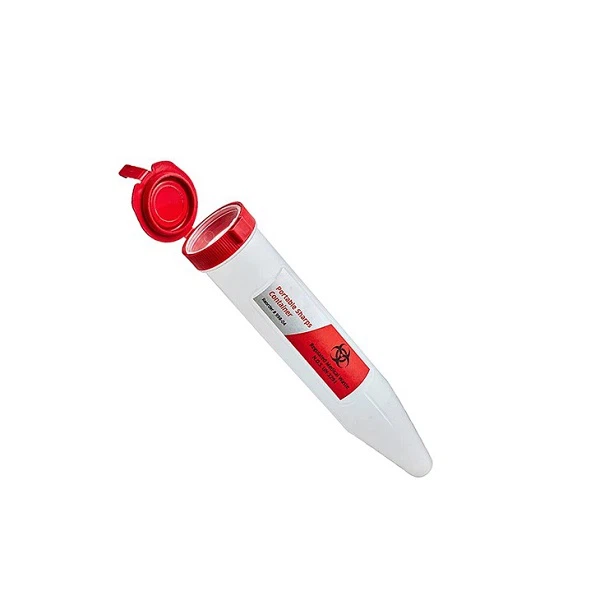
Enlightening Pallet offers a wide range of capacity options, from 0.1L to 30L. Beyond the common specifications mentioned above, we also provide options under 1L. The Small Solo Sharps Shuttle Container, with a 0.2L capacity, is particularly suitable for travel. It allows diabetics and travelers to store insulin needles, lancets, test strips, and other small items needed for daily management.
How to Determine the Right Size
The key to choosing the right capacity lies in assessing the amount of waste generated daily and the replacement cycle.
• Assess waste volume: Observe the number of needles, blades, etc., generated daily or weekly.
• Calculate replacement frequency: Ideally, the sharps container should last until the scheduled replacement date without overflowing.
• Match the usage scenario: Small capacity is suitable for mobile care and home patients; medium capacity is suitable for clinics; large capacity or trolley-style sharps containers are needed for centralized hospital collection points.
Selecting Safe and Reliable Materials
Sharps containers often hold dangerous, sharp objects, and robust materials are essential for safety. Low-quality materials are prone to cracking during loading or transportation, posing potential hazards. In contrast, high-quality plastics can maintain stability and sealing performance under intensive use.
Material Requirements
• Puncture resistance: The material should be sufficiently sturdy to withstand penetration by sharp objects such as needles, blades, and glass shards without cracking.
• Leakage prevention: The container should not leak liquids or biological waste during use or transportation to ensure environmental safety.
• Impact resistance: The material should possess shockproof and compression-resistant properties to prevent damage from dropping or collision.
• High-temperature/ sterilization resistance: The material should withstand high-temperature sterilization without deformation or releasing harmful substances.
• Chemical stability: It should not decompose or undergo harmful reactions when in contact with biological waste, disinfectants, or other chemicals.
• Aging resistance: It should not become brittle, crack, or lose strength when exposed to light, humidity, and heat for a long time.
• Lightweight and portable: On the premise of meeting safety requirements, the material should keep the sharps container moderately weighted for easy transportation or wall mounting.
Common Core Materials
Qualified sharps containers currently mainly adopt the following two plastic materials:
• High-Density Polyethylene (HDPE): Features high strength, impact resistance, and puncture resistance, making it suitable for high-risk environments.
• Polypropylene (PP): Offers chemical stability, light weight, and heat resistance, and is applicable to disposable medical products.
Enlightening Pallet sharps containers are made of medical-grade PP or HDPE material, which is more robust and durable than ordinary PP or HDPE material. They are leak-proof, impact-resistant, less likely to react with chemicals, and less prone to becoming brittle and cracking in humid, hot, and light-exposed environments.
Key Considerations for Purchase and Usage
Key Considerations for Purchase and Usage

Compliance of Appearance and Labeling
• International biohazard symbol: The container should be printed with a prominent biohazard symbol for quick identification of hazardous materials.
• Maximum fill line: Mark the maximum filling capacity (approximately ¾ of the volume) to prevent overfilling and potential risks.
• Color and warning: Sharps containers are usually red or yellow to ensure visual visibility and easy identification.
• Manufacturer and usage instructions: Clearly indicate manufacturer information, operating instructions, and disposal prompts for easy traceability and standardized use.
Safe Structural Design
• Puncture, leakage, and rupture prevention: The container material must be sturdy to ensure no damage during daily use and transportation.
• Lockable or one-time closure lid: The lid should be securely lockable or sealed once for good to avoid accidental opening.
• Needle removal device: Enlightening Pallet products can also be equipped with a needle removal device to reduce the risk of infection and prevent accidental injury.
Practical Detail Design
• One-time sealing device: Can be permanently locked after being full to prevent re-opening and improper operation.
• Transparent or semi-transparent upper lid: Facilitates observation of internal filling volume for timely replacement.
• Handle and hook design: Easy to carry, wall-mount, or fix, adapting to different usage scenarios.
• Smooth edge treatment: The container edges are smooth without sharp protrusions to prevent scratches during operation.
Safety Precautions for Use

Placement Requirements
Sharps containers shall be placed in proximity to the point of use to minimize the movement distance of sharps and reduce the risk of puncture injuries. Keep the container stable to prevent tipping and place it away from areas accessible to children and unauthorized personnel.
01
Filling Control
Overfilling beyond the maximum fill line (usually three-quarters full) is strictly prohibited to avoid increased puncture risk or seal failure caused by excessive loading.
02
Sealing and Labeling
Immediately seal and lock the container once full to prevent exposure of sharps. It is recommended to label with user, date, or department information for easy traceability and classification management.
03
Transportation and Disposal
Sealed sharps containers must be transported in compliance with medical waste packaging standards. Squeezing, dropping, or unauthorized opening is prohibited. They shall be uniformly recycled and disposed of by professional institutions to ensure safety and environmental protection.
04
Prohibited Illegal Operations
It is not allowed to replace sharps containers with beverage bottles or ordinary plastic boxes, nor to mix them with regular garbage. Reuse, unauthorized opening of sealed containers, or arbitrary dumping of contents is strictly forbidden.
05
Conclusion
Sharps containers are essential tools for protecting user safety and preventing environmental pollution. Choosing appropriate capacity based on usage scenarios, verifying compliance through materials and labeling, focusing on structural design to enhance safety, and standardizing usage and management are all crucial to achieving true safety, efficiency, and environmental friendliness.
Enlightening Pallet: Providing Safe and Compliant Sharps Containers for Healthcare Facilities
As a professional supplier of sharps disposal containers, Enlightening Pallet is committed to providing healthcare institutions with a wide range of high-quality sharps handling containers. We support customized services for capacity, shape, color, and warning labels, precisely adapting to the usage needs of different scenarios and ensuring operational safety and compliant waste disposal. Contact us for more information.