Plastic Pallets vs Wood Pallets: Total Cost of Ownership Comparison
Leave a message
Wood pallets usually cost less to buy. That's why most companies choose wood the first time they order pallets. But if a pallet gets loaded onto racking, runs through a food production line, or crosses a border, the purchase price alone doesn't tell the full story.
Here's the point worth remembering: the cheapest pallet to buy is not always the cheapest pallet to use. What actually matters is the total cost across the pallet's working life, including purchase, repair, replacement, cleaning, loss, freight, and disposal. This article breaks down that real cost, comparing plastic and wood pallets side by side.
Plastic Pallets vs Wood Pallets at a Glance

Before we get into the numbers, here's a quick side-by-side view.
|
Factor |
Wood Pallet |
|
|
Upfront cost |
Higher |
Lower |
|
Reuse capacity |
Built for high-frequency cycling |
Depends on quality and handling |
|
Moisture resistance |
Non-absorbent |
Warps and swells when wet |
|
Cleaning |
Easy to wash down |
Harder to sanitize |
|
Repairs |
Rarely needed |
Boards and nails can be replaced |
|
Export compliance |
No fumigation required |
Needs heat treatment for most countries |
|
Rack compatibility |
Purpose-built rackable models available |
Depends on design and grade |
|
Food and hygiene use |
Sanitary options available |
Limited by porous surface |
This table is just a starting point. The real answer depends on how a pallet is actually used, and that's what the rest of this article covers.
What Total Cost of Ownership Actually Means
Why plastic pallets cost more upfront. A plastic pallet is molded from HDPE or PP resin using a steel mold, which is a more involved process than cutting and nailing lumber. Rackable pallets need reinforced ribs, and some heavy-duty models require steel tube inserts to meet dynamic and static load ratings. So a basic ground pallet and a reinforced rackable pallet aren't built to the same cost model, and the purchase price only tells you the first part of the story.
What total cost of ownership includes. TCO covers every dollar a pallet generates over its working life: purchase price, replacement cost, repair cost, cleaning, losses, freight, compliance, and disposal. If a pallet is used once, the purchase price makes up most of the cost. If it's reused dozens or hundreds of times, that purchase price gets spread thin across every trip, which changes the math entirely.
Cost per trip is the better comparison. The formula is simple: total pallet cost divided by the number of successful trips. Say a wood pallet costs $20 and lasts 10 trips, that's $2 per trip. A plastic pallet costs $60 and lasts 60 trips, that's $1 per trip. Plastic isn't always cheaper to buy, but it can be cheaper to use.
When does a plastic pallet break even. Break-even is the point where the higher plastic price, spread across enough trips, matches or beats the wood pallet's cost per trip. In the example above, that happens around 30 trips. This is only an illustration, though. Actual break-even points shift based on pallet design, load weight, return rate, and how the pallet is actually handled day to day.
The Costs Most Buyers Overlook
Where wood pallets lose money. Boards crack, nails work loose, and stringers split with repeated forklift handling, all of which mean repair or replacement. Moisture makes it worse: wood absorbs water, and that leads to mold, rot, and warping, especially in humid climates or poorly ventilated warehouses. On top of that, most countries require heat-treated wood packaging for import, and loose nails or splintered boards can damage the goods riding on top.
Where plastic pallets lose money. The obvious one is the higher purchase price. Less obvious is loss and non-return: if a pallet is rated for 100 trips but only half of them come back, its real economic value drops fast. Wrong specification adds cost too, like putting a ground pallet on a rack it wasn't built for, or ordering a size that doesn't match your racking or forklift. Returnable plastic pallets also carry return freight, which needs to be factored into the total.
Return rate matters more than rated lifespan. Don't just ask how many trips a pallet is rated for. Ask how many trips you'll actually get back. That gap between theoretical lifespan and real recovery is usually where the true cost hides.
Why Wood Pallet Costs Are Climbing in 2026
Wood pallet economics have shifted this year. Combined U.S. tariffs on Canadian softwood lumber now exceed 40%, and the softwood lumber producer price index has climbed sharply since the start of 2026. Since Canada supplies roughly a third of U.S. softwood lumber, this hits pallet manufacturers directly.
The result is higher purchase prices and longer lead times for new wood pallets. Many procurement teams have assumed for years that wood is the cheaper default. That assumption is worth revisiting now, because the gap between wood and plastic pricing is narrower than it used to be.
Open-Loop vs Closed-Loop: Where Each Material Wins
Open-loop shipping. This is when pallets leave and don't come back, like shipping product to an overseas customer who keeps the pallet. In this setup, a low-cost export pallet or a wood pallet usually makes more sense, since there's no return trip to spread the cost across.
Closed-loop supply chain. This is when pallets cycle on a fixed route, moving from factory to distribution center and back again. Here, the plastic pallet's higher upfront cost gets divided across many more trips, and cost per trip drops fast. This is where the total cost of ownership case for plastic is strongest.
Pallet Design Changes the Cost Equation
Plastic pallets aren't one product. Different structures fit different jobs, and the cost logic shifts with each one.
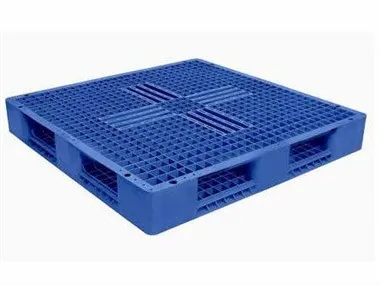
Rackable pallets are built for warehouse racking, distribution centers, and automated storage systems. Look at three numbers before buying: dynamic load, static load, and rack load. These measure different conditions, moving, resting, and elevated on a rack, and mixing them up is a common and costly mistake.
Stackable and ground pallets serve different needs. Stackable models save floor space in tight warehouses by stacking safely in multiple layers. Ground pallets are for floor storage where nothing gets racked. If your product just sits on the floor, you don't need to pay for rack-rated strength you'll never use.
Hygienic and export pallets round out the lineup. Hygienic pallets suit food, beverage, meat, and pharmaceutical production, with a smooth, non-porous surface and no nails or splinters to worry about. Export pallets are lighter and skip fumigation entirely, which shortens customs clearance. Anti-spill pallets solve a different problem altogether, containing leaks during handling, something a standard wood pallet simply can't do.
Freight and Storage Affect the Real Number
Storing empty pallets. After buying a thousand units, where do the empty ones sit between shipments? Pallet design directly affects warehouse footprint and how return freight gets scheduled.
Nesting and stacking. Nestable pallets fit inside one another, cutting the space needed for empty returns and storage. Stackable designs hold steady in tall piles, which frees up floor space. For exporters, how many pallets fit in a container is also part of the real cost, and it's worth checking before placing a large order.
A 5-Year Cost Example and How to Choose
Running the numbers over five years. Picture a company buying 1,000 pallets for a 5-year program. On the wood side, factor in the initial purchase, several rounds of replacement, repairs, and disposal fees. On the plastic side, factor in the initial purchase, minimal replacement, cleaning, return freight, and any loss if the loop isn't fully closed. Add it all up, divide by successful trips, and you get a real, comparable cost per trip for both options.
Matching the pallet to the job. One-way exports usually favor export-grade plastic or wood. High-frequency closed-loop logistics usually favor plastic. Food and pharmaceutical operations need hygienic plastic. Warehouse racking needs a rackable design. Plain floor storage doesn't need to pay extra for rack strength. Humid climates tip the scale further toward plastic. None of this means plastic wins everywhere, the right call depends entirely on how the pallet actually gets used.
A quick checklist before you order. Ask yourself six questions: What's the load weight? Floor storage or racking? How many trips do you expect? Will the pallet come back? Does it need regular cleaning? What handling equipment is on site? If standard sizes don't fit your operation, custom size, color, and logo options are usually available.
The Bottom Line, and Where to Go From Here
Wood pallets almost always win on sticker price. Plastic pallets can win on cost per trip when they're reused often and actually make it back. Which one fits your operation depends on your supply chain, not on the price tag alone.
If you're comparing suppliers, look for a manufacturer that covers rackable, hygienic, export, stackable, ground, and custom pallet types, works in HDPE and PP, and supports both bulk procurement and OEM/ODM production. Certifications like ISO9001, ISO14001, SGS, and FDA testing are worth checking too, since they say something about how consistently a factory actually builds to spec. We're Enlightening Pallet, and we've spent years building across most of the categories covered in this article, while holding to those same standards.
If you're running the numbers on an upcoming order, feel free to reach out. Send us your pallet size, load weight, application, and expected annual volume, and we'll help you compare the real long-term cost between options.
FAQ
Q: Are plastic pallets more expensive than wood pallets?
A: The purchase price is usually higher, but cost per trip can be lower if the pallet gets reused often and comes back reliably.
Q: Are plastic pallets cheaper in the long run?
A: In closed-loop operations, yes, often after enough trips to offset the higher purchase price. The exact number varies by use case.
Q: How many times can a plastic pallet be reused?
A: Typically dozens to over a hundred trips, depending on design and handling, though actual return rate matters as much as rated lifespan.
Q: When does a plastic pallet break even?
A: Usually somewhere in the range of a few dozen trips, depending on the price gap between wood and plastic and how the pallets are actually used.
Q: Are plastic pallets better for export shipping?
A: They skip the fumigation requirement that applies to most wood packaging, which can save time and paperwork at customs.
Q: Can plastic pallets be used in pallet racks?
A: Yes, with a rackable model rated for dynamic, static, and rack load matching your application.
Q: Are plastic pallets suitable for food and pharmaceutical use?
A: Yes, hygienic models have a smooth, non-porous surface that's easy to clean and sanitize.
Q: Can I order a small batch?
A: Yes, we support wholesale orders with a minimum order quantity of 300 pieces, and custom size, color, and logo options are available.